Italy ’98 Venezia San Marco panoramae Murano Glass famous bridges gondolae by foot by boat
|
.
.
.
.
.
.
.
.
.
.
.
.
.
.
.
.
.
.
.
.
.
.
.
.
.
.
.
.
.
.
.
.
.
.
.
.
.
.
.
.
.
.
|
1998 Italia: Venezia (Venice) Piazza di San Marco (St. Mark's Square) 2
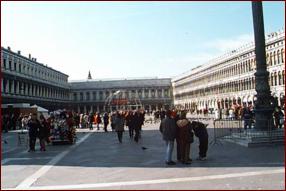 The Museo Correr runs the length of two sides of the piazza, and tells the story of Venice's history and present-day culture. Included in the museum are the crimson robes of the doges, rare maps of the city, election documents, historic Italian coins, a library of ancient tomes, Venetian and oriental spears and armor, and models of the galleys that once scouted this empire. The upper level is home to an art gallery that includes Crucifixion by Giovanni Bellini, The Courtesans by Carpaccio, and other important Italian works of art.
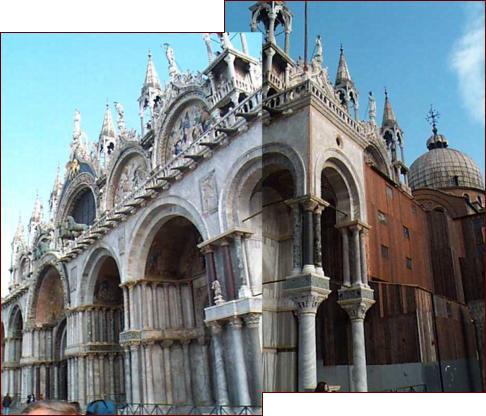
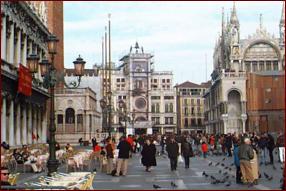 At the north and south ends of the piazza sit the Procuratie Vecchie and Procuratie Nuove, once the residences of the republic's most senior government officials. The Basilica di San Marco (St. Mark's Church), seen at right, lies in-between. The basilica began in 830 as a simple chapel to house the remains of Mark, Venice's patron saint. In the 11th century the chapel was rebuilt as a dramatic Byzantine-oriental basilica. Mosaicists were brought in to decorate the arches and domes. Five Romanesque portals, corresponding to the five Islamic-style domes, add to the ornate oriental feel of the basilica's exterior.
Over the centuries it has been embellished with trophies brought back from abroad to demonstrate Venetian power and thus the spiritual might of St. Mark. The bronze doors of the central gate came from Byzantium in the eleventh century, the bronze horses on the roof, in the thirteenth century. The origin of the four horses is not well known, but it is believed that they came from Costantinople. Their heads were separated from the bodies to make the transportation easier. After arriving in Venice, the cuts between neck and head were hidden by collars. They were cast in almost pure copper; harder to melt but easier to gild. The phrase "To capture the horses of St. Mark" means "to conquer Venice". Napoleon Bonaparte, taking this literally, had the horses (and much else from the city they were looting) carried to Paris. The horses were returned by the French Government after 1815.
 Inside, the mosaics have earned the basilica of St. Marks the name of Chiesa d'Oro (Church of Gold). Light shining through small windows in the domes reflects off their gilded surfaces, and the walls seem to radiate with golden light. The golden mosaics on the floors, ceilings, and walls cover 4000 square meters.
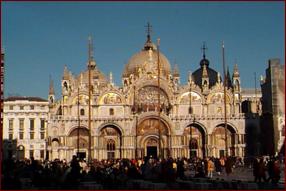 The San Alipio portal, the first on the left upon entering, is the only one decorated with an original 13th-century mosaic, a depiction of the Transfer of St. Mark's Body, and shows what the basilica looked like at the time the mosaic was created.
The Pala d'Oro, behind the high altar, is a golden altarpiece dating back 1,000 years and bejeweled in its present form in the 14th century. The altar contains over 4,000 precious stones including pearls, garnets, sapphires, emeralds, amethysts, and rubies.
The San Alipio portal, the first on the left upon entering, is the only one decorated with an original 13th-century mosaic, a depiction of the Transfer of St. Mark's Body, and shows what the basilica looked like at the time the mosaic was created.
The Pala d'Oro, behind the high altar, is a golden altarpiece dating back 1,000 years and bejeweled in its present form in the 14th century. The altar contains over 4,000 precious stones including pearls, garnets, sapphires, emeralds, amethysts, and rubies.
Because it was undergoing restoration, I have no photos of the Torre dell'Orologio (Clock Tower), built of gilt and enamel adorned with the statues of two bronze Moors. When it is reopened visitors will be permitted on the roof terrace, where they may watch the moors bang on the great bronze bell with their hammers every hour.
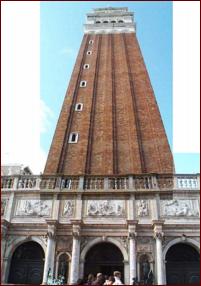 El Paron de Casa (The Lord of the House) is what Venetians call the bell tower of St. Mark's. On 14 July 1902 it collapsed without causing any fatalities.
The photo at right shows the new bell tower.
Inside are five large cast iron bells, each of which has a name and a purpose: Marangona rang mornings and evenings at the beginning and end of the work day, Maleficio rang for capital executions, Nona rang at the ninth hour, Trottiera called magistrates to meetings in the Palazzo Ducale, and the bell of Pregadi called senators to the Palace.
El Paron de Casa (The Lord of the House) is what Venetians call the bell tower of St. Mark's. On 14 July 1902 it collapsed without causing any fatalities.
The photo at right shows the new bell tower.
Inside are five large cast iron bells, each of which has a name and a purpose: Marangona rang mornings and evenings at the beginning and end of the work day, Maleficio rang for capital executions, Nona rang at the ninth hour, Trottiera called magistrates to meetings in the Palazzo Ducale, and the bell of Pregadi called senators to the Palace.
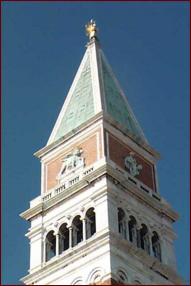
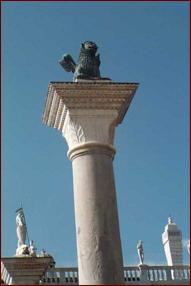
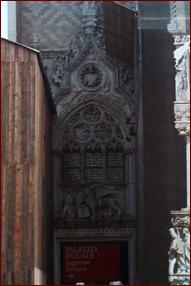
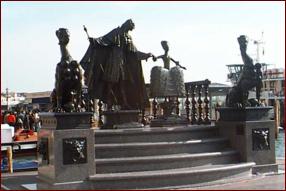
Here are some more things we saw around the Piazza di San Marco, before we headed out to explore the rest of the city.
|
 subscribe

